


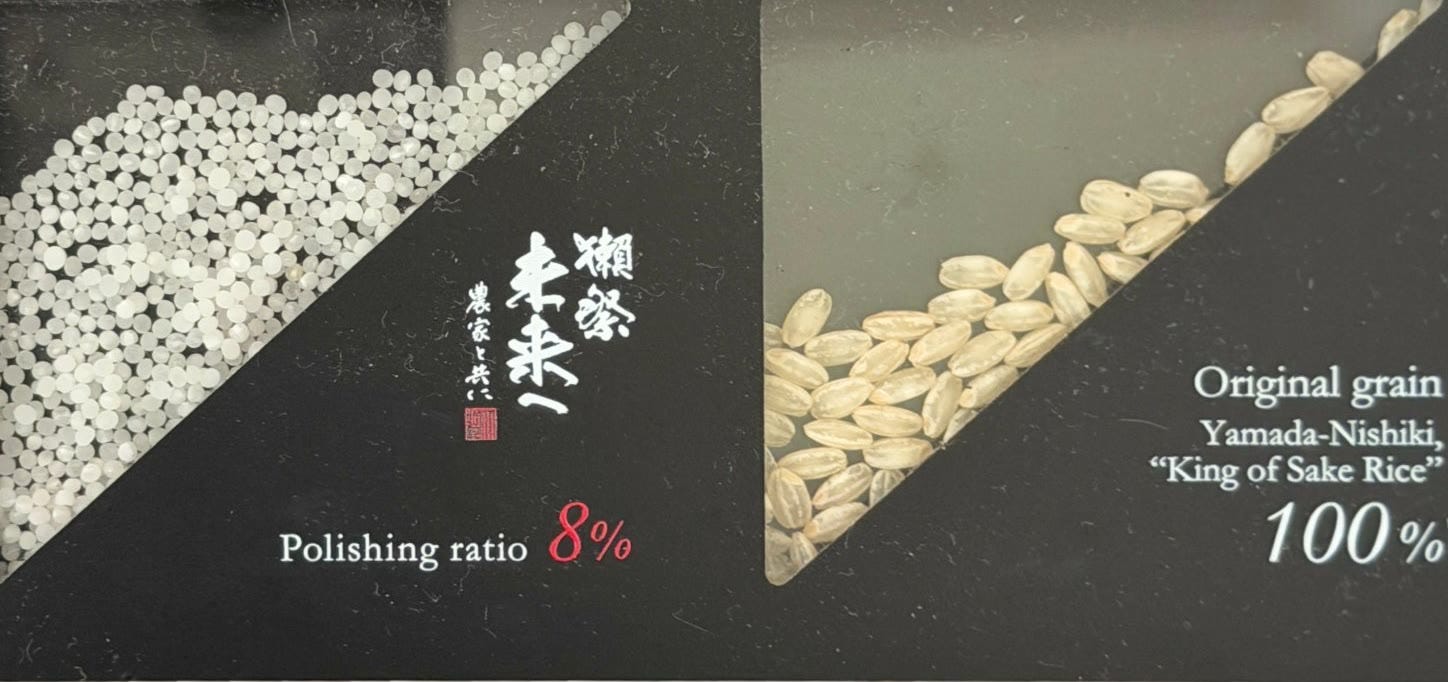
Yamada Nishiki is the most planted sake rice in Japan. Around thirty thousand tonnes were grown last year, and a single brewery bought about ten thousand six hundred of them. A third of the crop, to one company.
That scale changes what a brewery is responsible for. Every year Dassai runs a contest among its contract farmers for the best Yamada Nishiki of the harvest. From 2026 the winning lot — eighty bales — is bought for forty million yen: five hundred thousand yen a bale, more than twenty times the market price.
The judging standard has already been rewritten once. Classic grading rewards a large shinpaku, the opaque white core at the centre of the grain. Dassai mills further than almost anyone, and a large core collapses under the mill. So the brewery built its own criteria around its own method, and keeps editing them.
Then the thinking turned over entirely. Five to ten percent of any harvest comes out off-grade — grains that do not match in size, split lengthways, damaged by disease — and sake made from ungraded rice cannot carry a designation, so most breweries will not buy it. Rice with no real core to collapse, it turns out, can be milled further than the good stuff. The most highly polished sake Dassai makes is made from rice that cannot be graded.
The full interview is on the Grape and Rice journal — including what becomes of the 77 percent of each grain that never turns into sake, why the water in New York State made the first eight tanks unsellable, and the number that should bother anyone working with sake in Europe.
→ Sake Interview #16: DASSAI Inc. (Part Two)
Part one — no master brewer, data from every tank every day, and why that is not the same as a factory — is here.