


In Japan, the sake shelf moves with the seasons. Spring brings new releases. Autumn brings hiyaoroshi, released as the weather turns cooler. Aged sake, if it exists at all on a given shelf, tends to occupy one quiet corner, usually unlabelled as such, sometimes priced oddly, and rarely explained.
I grew up in that culture. Sake meant something recent. Something bright, often fragrant, sometimes ephemeral. I drank it with pleasure and did not look for what was missing.
Then I moved to the Netherlands. And something shifted.
At an importer tasting in Amsterdam, a bottle appeared that I did not recognise. The colour was deeper than anything I was used to: a warm amber, more sherry than ginjo. The smell stopped me. Caramel, something close to soy sauce, dried fruit, and underneath it all, a structural firmness that reminded me of a mature vin jaune: that same combination of oxidative depth and uncompromising acidity holding everything in place. There were several aged sake lined up alongside one another, each from a different producer, each showing something different from the last. Seeing them there, presented seriously, was one of the things that began to pull me in.
Why aged sake is rare, and why it was not always so
For most of the last century, Japan’s sake industry operated on a logic of volume and freshness. New sake was the product. Competitions, notably the National New Sake Appraisal, assessed freshly made sake for technique and quality. The market rewarded early release.
This was not always the case. Records suggest that a culture of aged sake existed in Japan in the samurai era, from roughly the 15th to the 19th centuries (Edo period). The shift came sharply in the late 19th century (Meiji era), following modernisation. Among the factors was taxation: unlike later frameworks, the Meiji tax system levied duty at the point of production rather than at the point of sale. A brewer who aged sake for several years was carrying costs on a product that had not yet generated any return, while the sake itself was changing and not guaranteed to improve. The rational response was to move stock quickly and keep turnover high.
By the time of the two World Wars, the conditions for thinking about ageing had deteriorated further. Under the severe strain of Japan’s economy, aged sake was not a category the industry had the means to prioritise. The logic of the period was compression: stretching supply, increasing yield, surviving the season. Holding premium sake back for years of careful maturation belonged to a different world.
It was only from the 1970s onward, and gathering momentum into the 1980s, that producers and drinkers began to have enough economic and cultural space to reconsider what aged sake might be. Interest in it as an intentional category, rather than an accidental one, started to re-emerge. This set the ground for more formal efforts: the Long-Term Aged Sake Research Association was established in 1985 with the goal of reviving production techniques and building a market. Although koshu remains the domain of dedicated connoisseurs, aged sake still commands little price premium over fresh sake — a reflection, perhaps, of how little the market has yet been built. But it is a real category, with a growing body of technical research behind it and some producers who treat it with genuine seriousness.
There is no single, universally agreed definition for aged sake. The terms koshu (古酒) and jukuseishu (熟成酒) are often used interchangeably, and in practice the terminology and ageing periods vary depending on the source and context.
What happens when sake ages
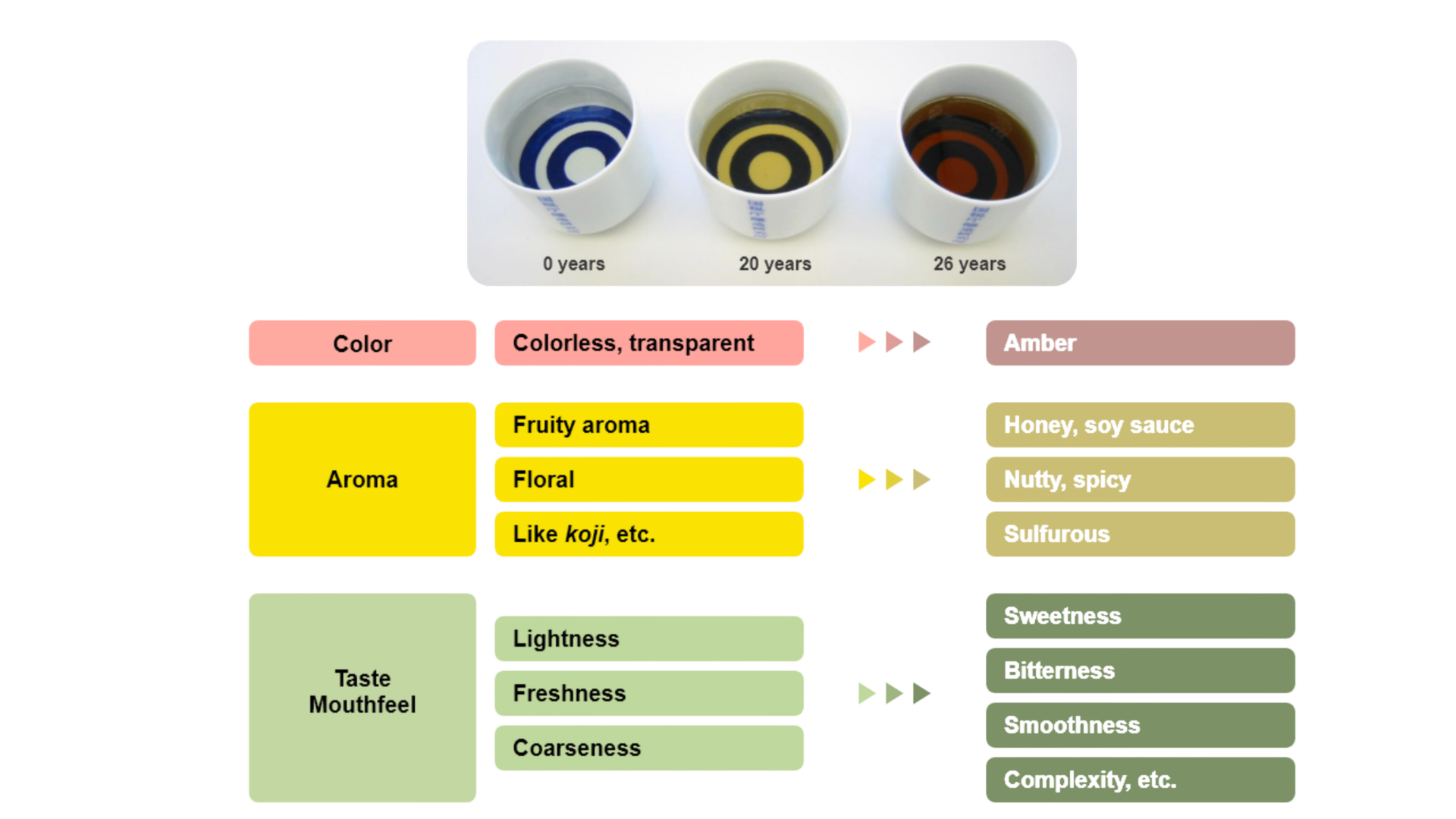
The most immediate change is colour. Fresh sake is pale, water-white. As it ages, it darkens: first straw, then gold, then amber, eventually approaching the colour of old Madeira or Oloroso. This is not a flaw. It is a sign of time.
The aroma changes more dramatically. Fresh sake, especially ginjo style, leads with esters: fruit, flowers, a particular brightness that can feel almost effervescent. That brightness fades over years. In its place come other things. Caramel and toasted cereal from Maillard-type reactions. Soy sauce-like savouriness. Dried fruit, honey, hints of curry or fenugreek. Something earthy beneath all of it. These are not the result of a specific production step, but time-derived complexity, a product of slow chemical transformation.
The palate changes too. High-acid sake can round out and integrate. The finish lengthens. Astringency, if it was ever present, softens. Umami deepens. The overall impression shifts from lively to layered.
For a wine drinker, the closest analogy might be an aged white wine with oxidative character: a ten-year-old white Rioja, a mature Jura vin jaune, or the older vintages of white Burgundy where hazelnut and earth have replaced primary fruit. The parallels are not exact, because the chemistry is different. But the experience is similar: something bright has given way to something more complex, and the question has changed from “what does this taste like now?” to “where has this been?”
Note: The key compounds associated with aged sake character include sotolon, which contributes fenugreek and curry-like notes; furfural, which brings a toasted, almond-like quality; various aldehydes; and ethyl esters of organic acids. DMTS (dimethyl trisulphide) is associated with the less desirable end of sake ageing, as described below.
What drives ageing: temperature, vessel, and time
Temperature, vessel, and time are the main variables. Of these, temperature is the most consequential.
At the colder end, sake is often stored below 5°C — a practice that slows chemical development and tends to preserve structure, encouraging subtle integration over time rather than rapid change. Some producers go further, storing sake at or near freezing, a practice sometimes referred to as ice-temperature storage. At these near-zero or sub-zero temperatures, the pace of development slows considerably further, extending the window over which a sake can be held without losing freshness. Whether it halts transformation entirely is unclear, but the slowing effect is well established.
At the other end, storage at room temperature allows Maillard-type reactions to proceed more quickly, producing more pronounced colour development, caramel and soy sauce-like character, and stronger tertiary aromas in a shorter time. A note worth making here for international readers: “room temperature” in Japan should not be imagined as a stable, mild condition year-round.
Vessel matters too. Most sake is aged in enamel-lined tanks, which are neutral and protective. Bottle ageing can produce a different result, with slower and more restrained development. Some producers also use traditional ceramic jars (kame). There are also now a small number of experimental and collaborative projects exploring wood ageing, including some involving French oak barrels. These remain marginal and exploratory, but they are worth noting as evidence that producers are testing the outer possibilities of the category.
Duration is a frame, not a guarantee. A sake aged ten years at near-freezing in bottle may be less evolved than one aged three years in a warm tank. The starting point matters equally: depending on the producer and the original character of the sake, the same number of years in storage will mean different things.
Which sake ages well
There is no single answer, but there are useful patterns.
Sake with firm acidity tends to age better than sake built around aromatic lightness. The acid acts as a scaffold, holding structure together as other elements shift. Kimoto and yamahai sake, which develop higher acidity and amino acid content through slow, lactic-driven fermentation, are often considered good candidates. So are genshu (undiluted sake) and sake with substantial umami.
Highly aromatic ginjo sake, designed to express delicate esters, tends to lose what it was made for as those esters fade. This is not true in every case, but it is a reasonable starting assumption.
Unpasteurised sake presents a different picture. Namazake may develop more quickly than pasteurised sake under similar conditions due to its live enzymes, so its ageing behaviour needs to be considered separately.
The design intention matters as much as the style category. Some producers make sake explicitly intended for long ageing: structures built for the future rather than for next month. Others age sake they have on hand and hope for the best.
Aged versus degraded: the question that matters most
This is where most confusion lives.
Not every sake that has spent years in storage is aged sake. Some of it is deteriorated sake. The difference is real, though the sensory line can be blurry.
What is called hineka (老香) in Japanese — roughly translated as stale odour — is a recognised fault in sake. It emerges from improper storage: exposure to heat, light, or oxygen in ways the sake was not designed to handle. The resulting smell is often described as cardboard, dusty, or a heavy, flat staleness that sits inert rather than evolving. This is not a character. It is a failure of conditions.
What separates hineka from desirable aged character appears to come down to which chemical compounds dominate. Research by the National Research Institute of Brewing found that sake identified as hineka-affected by professional tasters tended to show higher concentrations of polysulphides, particularly DMTS. Sake that had been intentionally aged and was commercially sold as koshu tended instead to show sotolon and carbonyl compounds in more prominent positions. The demarcation is not absolute, and sensory experience runs on a gradient, but the point holds: time alone does not produce quality. How and under what conditions the sake has been held matters at least as much as how long.
The practical rule for a consumer: aged sake from a producer who uses the word intentionally, and stores correctly, is very different from a bottle of fresh sake left in a warm cupboard for five years. One is deliberate. The other is not.
One example: what koshu can taste like
To understand what matured sake character actually means in the glass, it helps to start with a concrete example rather than a general description.
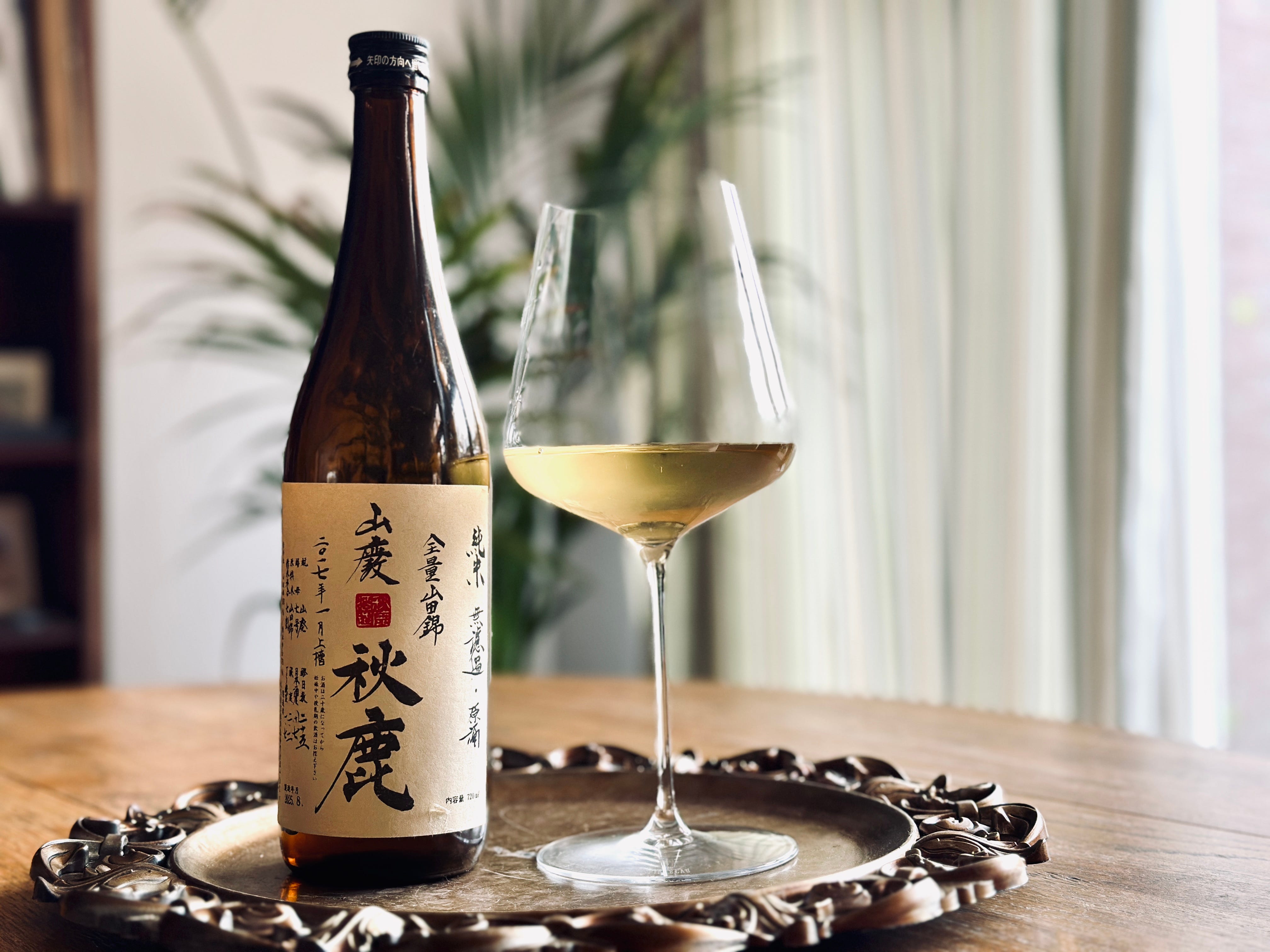
Akishika Shuzo, based in Osaka Prefecture, grows its own rice and releases much of its sake only after at least one year of ageing. Some bottlings are held back far longer — three, five, or more years in some cases. The Akishika Yamahai Junmai 2017 had been aged approximately nine years before release.
In the glass, it is a deep amber. The nose is pronounced and complex: caramel and brown sugar upfront, followed by toasted cereal, fenugreek, honey, and a savoury undercurrent of meat broth and something close to miso. There are earthy, oxidative nuances, and beneath all of it a clear grain-derived backbone that tells you this was well-made sake to begin with. No faults. Just depth.
The palate is dry, with high acidity that brings structure and a sense of freshness despite the maturity. Full-bodied, with a slightly grainy texture. The flavour follows the nose: caramel, toasted cereal, savoury broth, gentle bitterness that extends the finish. The alcohol is high but well integrated. The finish is long and dry, driven by acidity and umami, with lingering cereal notes that persist for twenty seconds or more.
Best served at around 15 to 18°C, or lightly warmed to around 40°C, where the umami opens further.
If you want to explore aged sake
The first recommendation is to let someone else do the ageing.
A handful of breweries in Japan treat aged sake as an important part of what they do, among them Daruma Masamune, Kidoizumi, Tamagawa, Kenbishi, Akishika Shuzo, and Mukai Shuzo.
It is also worth knowing that koshu does not only enter the market as a producer-designed release. Importers sometimes hold sake back before making it available, allowing additional development in their own conditions. Specialist sake bars and dedicated venues may age bottles on their premises. In Japan, there are venues that focus almost entirely on aged sake, offering opportunities to taste across producers and vintages in a way that is difficult to replicate at home.
If you are drawn to experimenting at home, the principles are consistent with good sake storage: low and stable temperature, darkness, and minimal oxygen exposure. Keep records of what you have and when it went in. That said, outcomes depend heavily on the sake itself. Some sake are resilient enough to evolve positively even in conditions that would damage something more fragile. A producer I met stores sake at what would broadly be described as room temperature in a part of Japan where indoor summer temperatures can rise above 35°C, and the results showed genuine, delicious aged character rather than spoilage. This is not a suggestion to attempt the same without experience or in conditions more challenging than you can manage. It is a reminder that the starting material matters most. The best home experiments begin with sake that was built to last.
A note on workshops
Much of what this article touches on — the character of aged sake, their difference in style, how temperature and time and structure interact — is easier to understand through tasting than through reading. I explore these questions in a workshop format in Amsterdam, comparing young and aged sake, and examining how the structural ideas discussed in my earlier writing on aged sake play out in the glass over time. If you want to taste and understand aged sake more directly, you are welcome to join.

Sake for Wine Lovers #4 — Aging Journey Tasting
Notes
Hineka (老香) and aged character: The distinction between desirable aged character and stale, off-putting hineka is one of the more nuanced questions in sake evaluation. Research from Japan’s National Research Institute of Brewing points to DMTS (dimethyl trisulphide) as a key marker of hineka-type degradation, while sotolon and related carbonyls are associated with positive aged character. The sensory boundary is a gradient rather than a clean line, and professional evaluation differs from consumer experience.
Key ageing compounds: Sotolon contributes fenugreek and maple-like notes; furfural brings toasted almond character; diethyl succinate adds fruity richness in some aged sake; DMDS and DMTS, at elevated levels, are associated with unwanted odours. The Maillard reaction — a reaction between sugars and amino acids accelerated by heat and time — contributes colour development and browning-associated aromas including caramel and toasted cereal.
Long-Term Aged Sake Research Association: Founded in 1985, the Association works on production technique exchange and market development for aged sake. Their working definition — sake aged three or more years after pressing, excluding sugar-added types — provides a practical reference point in the absence of a legal definition.