


I’m a wine and sake educator based in Amsterdam. This year, wanting to refresh my sake knowledge (which keeps evolving), I decided to take the JSA sake diploma exam in both Japanese and English (and passed)—a perfect excuse to visit Japan twice.
Both trips were officially for the exams. In reality? I spent most of my time visiting breweries and drinking sake you can only find in Japan.
Today I want to share what I actually ate and drank during those August and October visits—in a lighter tone than my usual brewery interviews.
What did I eat? No sushi. No yakiniku. No ramen. Instead, this is the kind of food that sake professionals seek out: dishes that might seem strange at first glance but make complete sense the moment you pair them with the right cup.
The place: Yunimoni, a tiny counter-only bar in Osaka. No English menu. No tourist crowds. Just locals who know their sake and a chef who knows exactly what to cook alongside it.
Here are four dishes—authentic tapas-style food, each with a fantastic twist. Let me show you how I think about pairing.
Sanma Mousse on Maitake

The first dish arrived looking like chocolate mousse perched on golden-brown mushrooms. A halved sudachi (Japanese citrus) sat alongside. I had to ask what I was looking at.
Sanma is Pacific saury—a sleek silver fish whose kanji (秋刀魚) literally means “autumn sword fish.” To prevent overfishing, the fishing season traditionally opens around August 10th, but the true peak comes in September and October. In Japan, when sanma appears at markets alongside the autumn sake release called hiyaoroshi, everyone knows: autumn has arrived. The classic preparation is simple—grilled over charcoal and finished with a splash of soy sauce.
Here, instead of that familiar char, the kitchen had transformed sanma into something impossibly light: a mousse with the texture of silk, all the good parts of blue-fleshed fish concentrated, the harshness left behind. The maitake mushrooms beneath had been sautéed until their edges crisped.
Serving them together isn’t creative fusion—it’s seasonal common sense.
The sake: Tamagawa “Iwai” Junmai Ginjo, 2023BY. Tamagawa is made in Kyoto by British toji Philip Harper (more on him in my previous article). “Iwai” means celebration—it’s also the name of a Kyoto-grown rice variety used here. The result is round and generous, with just enough acidity to stay balanced.
Sanma carries a characteristic bitterness that some find challenging. But matched with sake’s umami, that bitterness becomes pleasant, almost appetizing. The sake’s gentle sweetness echoed the mousse, creating resonance rather than contrast. And the layered umami in this dish—fish, mushroom, fermentation—found a partner in the sake’s own depth.
Each sip encouraged another bite. Each bite demanded another sip.
Seared Bonito with Egg Tartar and Shutō
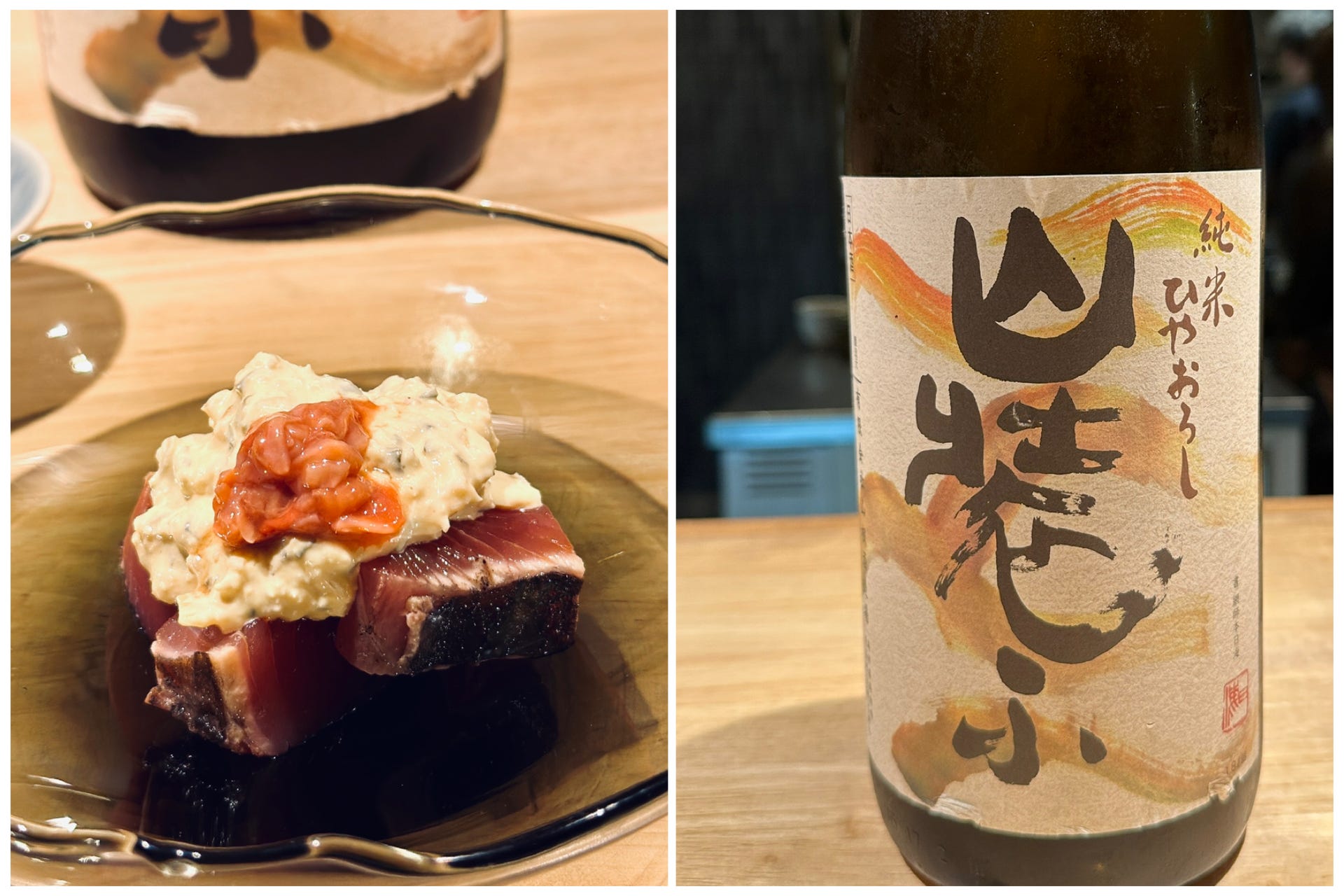
This one looked deceptively simple: thick slices of seared bonito topped with golden tartar sauce, finished with a small dollop of something rust-colored.
Seared bonito is one of Japan’s great preparations—the fish charred over extremely high heat so the exterior blackens while the interior stays cool and raw. The contrast between smoky crust and silky flesh is thrilling. But this version went further. The egg tartar added richness and body. And then there was the shutō.
Shutō is hard to explain. It’s the fermented, salted internal organs of bonito, aged until deeply savory and almost paste-like. Think of it as Japan’s answer to anchovy paste or bottarga—concentrated, funky, intensely umami. People buy it as a luxury gift and ration it carefully.
Here, just a small amount sat atop the tartar, adding a high note of concentrated flavor to an already complex dish.
The sake: Hiokizakura Junmai Hiyaoroshi Yamayosoou, served cold. A classic autumn release—soft, round, mellow.
This pairing was all about umami meeting umami. The bonito brought savoriness. The tartar added richness. The shutō contributed fermented depth. These layers didn’t compete—they amplified each other, like voices joining in harmony. The sake’s own umami became part of the chord, filling in the spaces between fish, egg, and fermentation.
Three sources of umami, one cup of sake to bind them together.
Nikogori with Nagano Purple Grapes

In a ceramic bowl sat what appeared to be a small cube of amber-colored jelly, studded with slices of deep purple grape.
Nikogori is not a sauce or dressing but a state of matter. When proteins with high collagen—typically from fish or meat—are cooked and cooled, the liquid sets naturally into a soft jelly. No gelatin added. Just the ingredient’s own substance, transformed by temperature.
What makes nikogori special is what happens when you eat it. At room temperature, it holds its shape. But in your mouth, it begins to melt—your body heat liquefying the jelly back into a silky, savory liquid. The Nagano Purple grapes added sweetness and slight acidity, creating contrast within a single bite.
The real revelation came from the chef’s instruction: Keep the nikogori in your mouth for three seconds after sipping warm sake, then let it melt.
The sake: Hiokizakura Junmai Hiyaoroshi Yamayosoou, served warm.
Here’s what happens during those three seconds. You sip warm sake. You place nikogori on your tongue. The sake’s heat begins to break down the jelly’s structure. For a moment, solid and liquid exist together. Then the nikogori releases entirely, mixing with the remaining sake in your mouth—transforming into something neither jelly nor drink, but richer and more unified than either.
Temperature does the work here. Warm sake speeds the phase change. The hiyaoroshi’s soft, round character matches the nikogori’s delicate texture rather than cutting through it. The grape’s acidity provides a bright finish.
Food as experience. Three seconds of attention, and a dish becomes unforgettable.
Nuta-ae (Fish with White Miso Dressing)
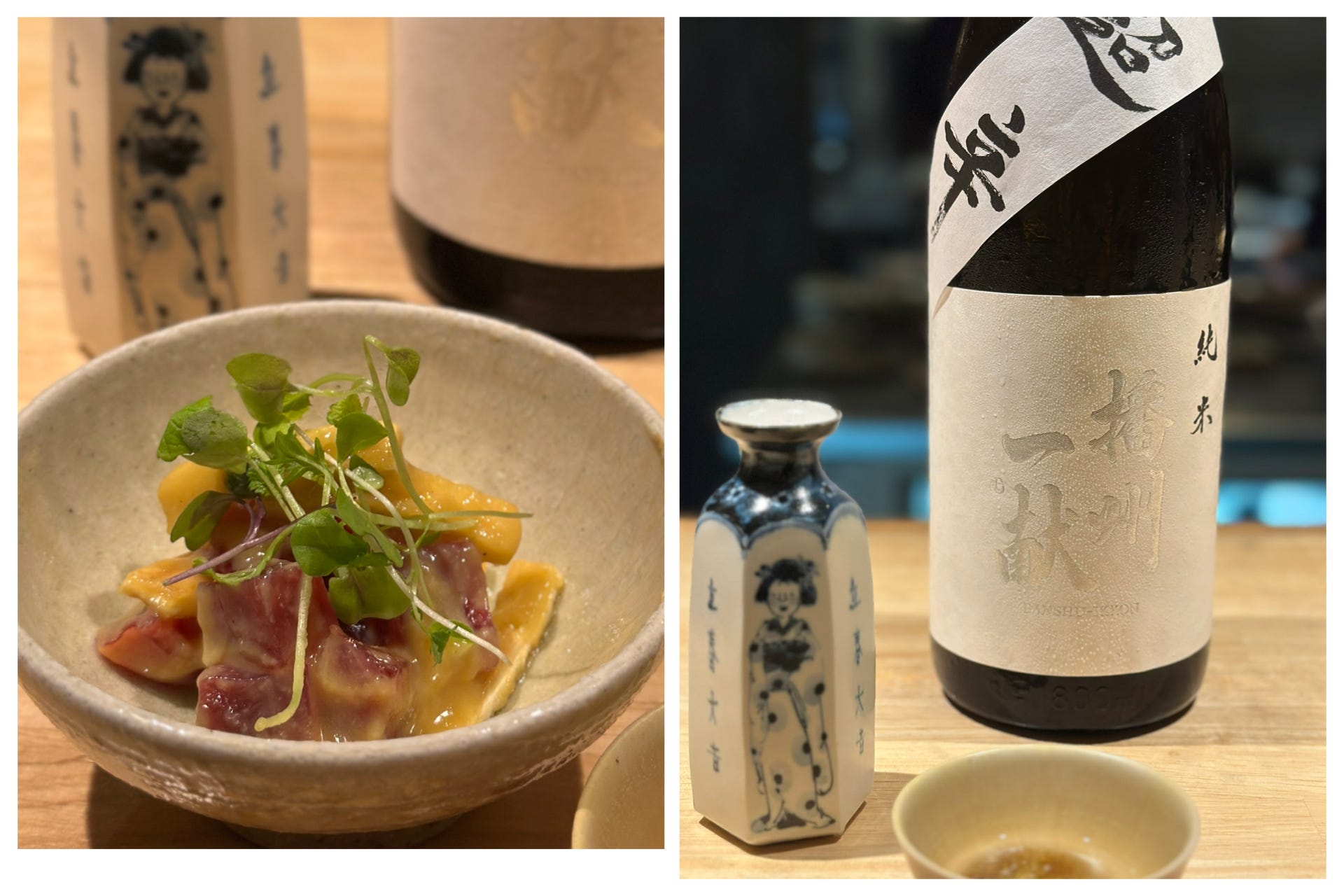
This one looked almost like a Hawaiian poké bowl: cubes of raw fish in a pale sauce, topped with microgreens.
Nuta is one of Japan’s quiet classics—a dressing made from white miso, rice vinegar, and a touch of sweetness, traditionally from mirin. The flavor is gentle and round, with fermented depth balanced by brightness. Japanese grandmothers have been making this for generations, usually to dress spring onions or seafood. It’s home cooking, not restaurant cooking—until places like Yunimoni started treating it with the seriousness it deserves.
Here, pristine slices of fish lay beneath a generous coating of nuta dressing, the creaminess of the miso wrapping around each piece.
The sake: Banshu Ikkon Junmai, from Hyogo Prefecture. Known for its dryness and precision.
This pairing seemed counterintuitive at first—a dry sake with a creamy, sweet-inflected dish?
But here’s where fermentation changes everything. The sweetness in nuta doesn’t come from refined sugar. It comes from the same process that creates sake: fermentation transforming starches into sugars. The miso has its own sweetness from months of slow fermentation. The mirin(cooking sake) adds sweetness from rice fermentation. And sake carries residual sweetness from the same enzymatic magic.
These sweetnesses recognize each other. They harmonize at a level that cane sugar never could.
Fermented meets fermented. The conversation between cup and plate felt almost inevitable.
What These Pairings Remind Me
These four dishes share something important. They’re not flashy. They don’t photograph particularly well (though I tried). They require explanation before they can be appreciated.
But that’s the point.
Japanese cuisine, at its deepest level, is about using ingredients fully and honoring the seasons that bring them. Nikogori exists because someone noticed cooking liquid sometimes sets when cooled. Shutō exists because someone found value in parts of the bonito that might otherwise be discarded. The sanma mousse exists because autumn brings this fish, and a skilled kitchen found a new way to honor it.
And sake exists to accompany all of this—not as an afterthought but as a partner. The right sake doesn’t just pair with a dish. It transforms it.
For those planning a trip to Japan: go beyond the familiar pleasures. Find a counter seat at a place that serves what locals drink. Order what the person beside you is eating. Accept that you might not know what it is until you taste it.
Experiencing another culture in a different country—that’s the joy, isn’t it? And it goes both ways.
Now, today is Sinterklaas here in the Netherlands—the most important day of the year for kids. Time for this mother to get back to her behind-the-scenes elf duties.
Tot ziens!